Austin Housing Market Update | August 2026Inventory Is Still High—But Buyer Activity Is Picking UpAustin's housing market is giving us a more interesting signal in August: inventory remains

Dated: February 7 2026
Views: 919
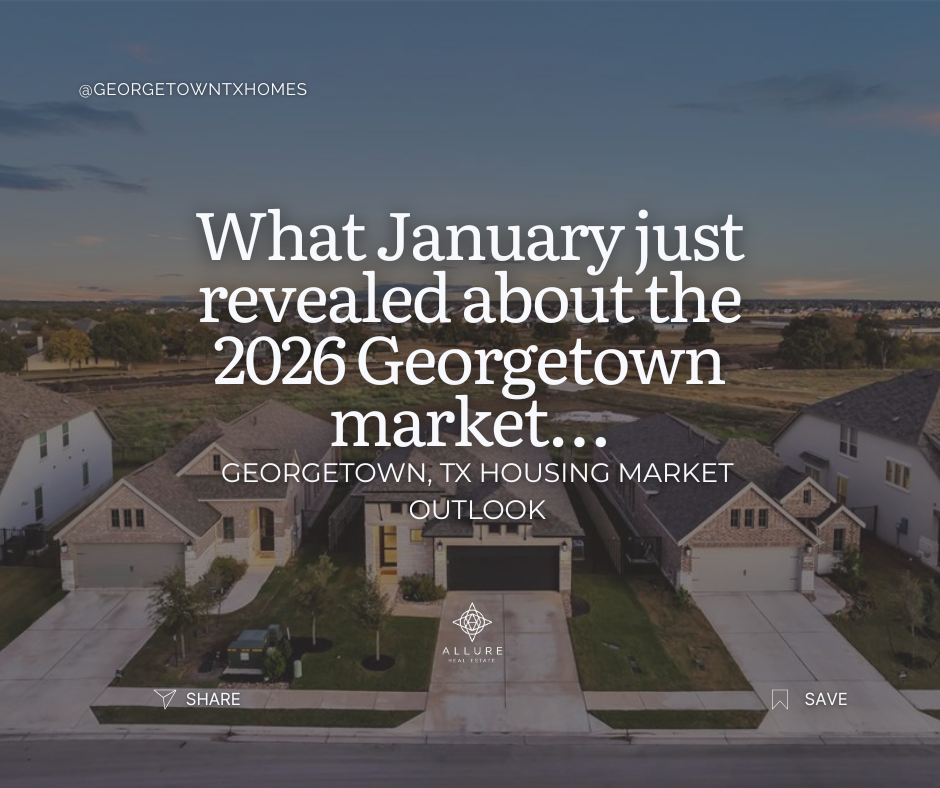
Georgetown, TX Housing Market Outlook: What 2025 Set Up — and What January Is Already Telling Us About 2026
The Georgetown housing market didn’t crash in 2025 — it recalibrated. As we move into 2026, the story is less about demand disappearing and more about how supply, pricing strategy, and buyer behavior reshaped the market.
If you’re planning to buy or sell in Georgetown this year, understanding why the numbers look the way they do is just as important as the numbers themselves. January data, in particular, is starting to reveal where this market is headed next.
2025 in Review: Fewer Sales, Steadier Prices, Longer Timelines
At a glance, 2025 looks slower — and it was — but the slowdown tells a very specific story.
133 closed sales (down 28.5% year over year)
Median sales price: $430,000 (up 1.5% year over year)
Median days on market: 88 (up 27 days from last year)
43 of those sales were new construction, accounting for nearly one-third of all closings
This wasn’t a market losing value. It was a market absorbing inventory — particularly new construction — while buyers became more selective and more price-sensitive.
Prices held. Volume slowed. Timelines stretched.
That combination is the definition of a recalibration.
What the Monthly Data Shows: Stability, Not Decline
Looking month by month, median prices fluctuated throughout 2025 but stayed within a relatively tight band, closing the year at $451,122 in December and rising again to $430,000 in January 2026.
This matters.
Despite fewer transactions, pricing did not collapse — and in several months, 2025 medians outperformed 2024. That’s a strong signal that Georgetown buyers didn’t leave the market; they became more disciplined.
Negotiation Became the Norm — and That’s Healthy
Throughout 2025 and into January 2026, homes consistently closed 2–3% below asking, with the average list-to-close ratio tightening slightly but remaining stable.
By January 2026:
Homes closed at roughly 3% under asking
Sellers captured about 91% of original list price
This isn’t distress pricing. It’s rational pricing.
Buyers negotiated. Sellers who were realistic still sold. Overpricing was corrected — not rewarded.
Where Demand Is Concentrated: The $300K–$399K Sweet Spot
One of the clearest patterns emerging from the data is where buyers are actually competing.
The strongest demand is concentrated in the $300,000–$399,000 range.
What that means in practice:
Sellers priced within this range are seeing faster activity and, in some cases, multiple offers
Sellers in the low $400s who price strategically — just under the next psychological threshold — are capturing that same buyer pool and outperforming expectations
This is a critical message for both sides of the market.
For sellers, pricing for demand (not aspiration) is winning.
For buyers, this is the most competitive segment — and waiting too long here can mean losing the home that checks the most boxes.
January 2026: Supply Down, Demand Up — and That’s a Leading Signal
January delivered one of the most important signals we’ve seen in months:
269 new listings (down 16.2% year over year)
224 new under-contract properties (up 16.1% year over year)
In other words: supply fell sharply while demand increased.
We saw this same pattern begin in December — and it’s important to remember that real estate indicators are lagging. Contracts today become closings months from now.
This shift suggests the market is already tightening beneath the surface.
What This Means Looking Ahead to Summer 2026
If you’re a buyer hoping to make a move later this year, January’s data matters more than most people realize.
When fewer homes are coming to market and more buyers are going under contract, affordability and leverage tend to compress before it shows up in headlines or median prices.
Waiting for summer could mean:
More competition
Fewer choices
Less negotiating room
For sellers, this early tightening creates opportunity — especially if your home aligns with where demand is already strongest.
The 2026 Outlook: Strategic, Value-Driven, and Moving Earlier
Georgetown is entering 2026 as a market defined by value clarity, not volatility.
Buyers are active, but intentional
Sellers are rewarded for smart pricing and preparation
Early-year momentum suggests decisions are shifting forward on the calendar
This is not a market to time emotionally. It’s a market to navigate strategically — with data, context, and a clear understanding of where demand is actually flowing.
If you’re planning a move this year, the window to act from a position of strength may be earlier than you think.

Born and raised in the heart of Austin, Cara Jane Welch offers a perspective on the Texas Hill Country that few can match. Her deep-rooted connection to the region began in Hutto when it was still a r....
Austin Housing Market Update | August 2026Inventory Is Still High—But Buyer Activity Is Picking UpAustin's housing market is giving us a more interesting signal in August: inventory remains
Georgetown Housing Market Update | August 2026More Homes Hit the Market—But Buyers Are Absorbing ThemIf you’ve been waiting for Georgetown’s market to clearly tip toward buyers or
September always feels like a little reset here in Austin. The days are still warm, but there’s a subtle shift in the air as summer winds down, kids head back to school, and our calendars
Georgetown Housing Market Update: July 2026July was another active month for the Georgetown housing market, with more homes selling than this time last year despite buyers continuing to enjoy plenty
 Austin Board of REALTORS® Copyright ©2026 All rights reserved.
33. Required DMCA Notice
The Digital Millennium Copyright Act of 1998, 17 U.S.C. §512, the DMCA, provides recourse for copyright owners who believe that material appearing on the Internet infringes their rights under U.S. copyright law. If you believe in good faith that any content or material made available in connection with our website or services infringes your copyright, you (or your agent) may send us a notice requesting that the content or material be removed, or access to it blocked. Notices must be sent in writing by email to DMCAnotice@MLSGrid.com. The DMCA requires that your notice of alleged copyright infringement include the following information: (1) description of the copyrighted work that is the subject of claimed infringement; (2) description of the alleged infringing content and information sufficient to permit us to locate the content; (3) contact information for you, including your address, telephone number and email address; (4) a statement by you that you have a good faith belief that the content in the manner complained of is not authorized by the copyright owner, or its agent, or by the operation of any law; (5) a statement by you, signed under penalty of perjury, that the information in the notification is accurate and that you have the authority to enforce the copyrights that are claimed to be infringed; and (6) a physical or electronic signature of the copyright owner or a person authorized to act on the copyright owners behalf. Failure to include all of the above information may result in the delay of the processing of your complaint.
 Information provided courtesy of LERA MLS. IDX information is provided exclusively for consumers' personal, non-commercial use and may not be used for any purpose other than to identify prospective properties consumers may be interested in purchasing. Information is believed to be accurate but not guaranteed. Provided courtesy of LERA MLS. Copyright 2026 LERA MLS, All Rights Reserved. Data last updated September 20, 2026 4:46 PM UTC
 Central Texas MLS | Four Rivers Association of REALTORS® All information deemed reliable but not guaranteed. All properties are subject to prior sale, change or withdrawal. Neither listing broker(s) or information provider(s) shall be responsible for any typographical errors, misinformation, misprints and shall be held totally harmless. Listing(s) information is provided for consumer's personal, non-commercial use and may not be used for any purpose other than to identify prospective properties
consumers may be interested in purchasing. The data relating to real estate for sale on this website comes in part from the Internet Data Exchange program of the Multiple Listing Service. Real estate listings held by brokerage firms other than Allure Real Estate may be marked with the Internet Data Exchange logo and detailed information about those properties will include the name of the listing broker(s) when required by the MLS. Copyright ©2026 All rights reserved.
Last Updated: September 20, 2026 5:43 PM UTC
Show More...
Central Texas MLS | Four Rivers Association of REALTORS® All information deemed reliable but not guaranteed. All properties are subject to prior sale, change or withdrawal. Neither listing broker(s) or information provider(s) shall be responsible for any typographical errors, misinformation, misprints and shall be held totally harmless. Listing(s) information is provided for consumer's personal, non-commercial use and may not be used for any purpose other than to identify prospective properties
consumers may be interested in purchasing. The data relating to real estate for sale on this website comes in part from the Internet Data Exchange program of the Multiple Listing Service. Real estate listings held by brokerage firms other than Allure Real Estate may be marked with the Internet Data Exchange logo and detailed information about those properties will include the name of the listing broker(s) when required by the MLS. Copyright ©2026 All rights reserved.
Last Updated: September 20, 2026 5:43 PM UTC
Show More...
